Pages

Showing posts with label Sea Turtles. Show all posts

Thursday, July 23, 2015

It is hatching time - Sea Turtle part 2

After I've discovered and identified a sea turtle's crawl, I determine whether it is a nest or not and if it is, then I go ahead and verify where the chamber is, apply a self-releasing screen and give it a number. From then on we keep our eyes on the nest and give it a daily look/see - making sure that all is well until it is hatching time - a nest will hatch anytime from day 45 to 70.
Most days begins with a gorgeous view - how very fortunate we are to have this in our back yard!

And the journey begins - a predation is discovered....

Sometimes the coyotes beat us to the punch and have a feast with total disregard to the sea turtle population. When this happen we take an inventory of the eaten/damaged eggs and clean up the chamber as well as we can - we then fill it up with fresh sand and hope that the rest of the clutch will continue to incubate and be successful.

With field guide at hand - the prints are correctly identified and recorded.
 Also, part of the patrol is being on the lookout for anything and everything that could be of danger to the sea turtles. During the season it is crucial to clean up the beach after using it - such as removing canopy, chairs, toys etc but most
importantly to fill up holes such as these because they are hazardous to the adult but especially for the hatchlings.
As the season progress - the excitements starts to build up, as you can see here this was a nest that went unnoticed and hatched on its own - look at all those tiny crawls heading to the ocean!

 Here you see another - this one had been labeled and screened. We love to see all those prints heading in the right direction, a sure sign of a successful hatch.
 We then allow several days to pass - giving ample time for the hatchling to get out before we conduct an inventory - this particular nest had 64 eggshells (hatched), 36 unhatched, 1 dead hatchling, 3 live hatchlings, 0 pipped live and 5 pipped dead - making this a 106 egg clutch.
Sometimes we find live hatchlings in the chamber, if it is early enough and safe - we let the hatchlings go - otherwise we hold them until night time at which time we release them in the ocean at the location where they were born. The imprint on the beach helps them to come back to the same area some 20+ years later to lay their own eggs. Also, notice how one of the hatchling looks slightly different from the others - it turns out that the female sea turtle gets sperms from many males and after data study it has been determined that a clutch has many different dads - pretty cool, hey?
And so, we wish them luck on their incredible journey - 1 in 1000 will make it to adulthood - they need all the help they can get.
And if you are ever at Ding Darling, make sure to stop in the Visitor Center and look at the Sea Turtle interactive display they have - it is quite informative.


And this is a side view of the egg chamber that sits 2-3 ft down - the chamber has the shape of an inverted light bulb - the hatchling emerge in the middle of the night when it is dark and cool. The beaches are dark and the hatchling will head to the brightest horizon - which is the ocean. If you happen to be on the beach at night, refrain from using a flashlight because this can be a cause for disorientation for the sea turtles - as a result they will wander inland and will die of exhaustion, dehydration or predation. Just remember, after 9, it's turtle time.

Tuesday, September 3, 2013

A Turtle's Journey

Now that turtle season is closely coming to a wrap-up - I've compiled some photos and will share with you what I've learned and what I do as a Turtle Patrol.
I begin my day before the sun rises - a few mornings per month I get to walk the east end of Sanibel under the moonlight - very special if I may say so myself. I walk along the high tide line, looking toward the sand dunes and looking to see whether or not a turtle came during the night to lay her eggs.


The tell tale signs are the turtle tracks. With the few years that I've been doing this as well as the training that I've received from Amanda - the SCCF Biologist - I can usually determine whether or not the turtle actually nested or just took a stroll up and changed her mind about the spot.

This was one of those very rare occasion when the turtle actually deposited her eggs while the sun was rising - maybe she was running late. As respect for our wildlife, we like to keep our distance and give her as much space as possible so that she doesn't get stressed out. Though.....truth be known....the turtles actually go into a trance while laying their eggs and the whole process cannot be interrupted. 

Job well done! After covering up her eggs with sand using her front and hind flippers, she turns around and returns to sea. This turtle will most likely return to a nearby beach in a couple of weeks to lay more eggs and will probably repeat this process a few more times. She will lay an average of 400 eggs - give or take a few - during that one summer. Once laying season is over, she will return in 2 years if all goes well.

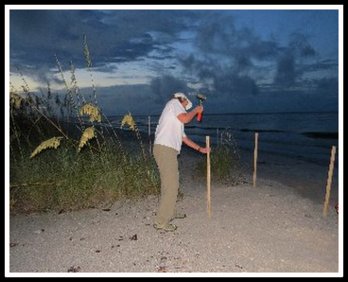
This is how we mark the nests along with signs to keep people away and not disturb the nesting site.

A grid is sometimes used over the nesting area in order to keep the predators away from the eggs. Coyotes, Bobcats and Racoons have been known to have a meal from time to time.

This was on the west end of Sanibel - where we access the beaches with a Jeep - we cover 7 miles or so and take care of many nesting sites.


This is the vehicle being used on the Captiva beaches - that is another 6 miles of turtle patrol.

As the daily patrol progresses, we are often blessed with a beautiful sunrise which always makes me smile and reminds me how grateful I am for my life and to be able to do the things that I do.

Time goes and marches on and pretty soon it is turtle hatching time - our duties changes from watching for new nesting to baby turtle tracks and signs of hatching.

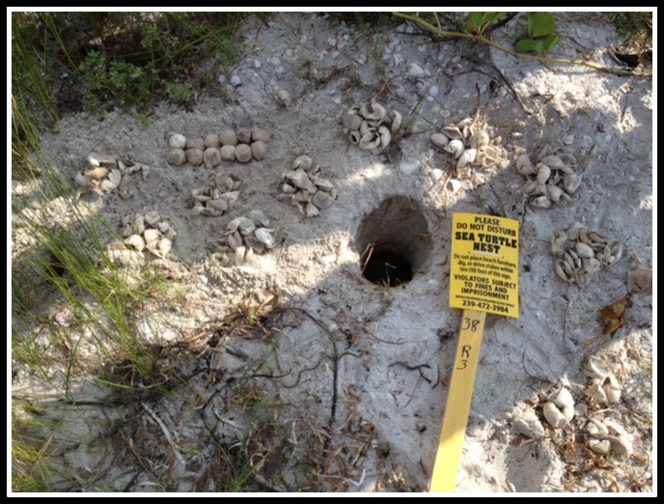
This is a perfect example of what a hatched nest looks like - a perfect round hole where the hatchlings have emerged.....if only the signs were as simple as that....sometimes we don't get all those signs especially when we get downpours overnight.

Three days after the nest hatched, we do data collection for the state...in this particular case we had 12 unhatched eggs and 98 eggs hatched that went to sea  and that's what we like to see.

Sometimes we come across little hatchlings still lingering in the nest chamber - we keep them in a warm and dark place until the sun sets and then release the hatchlings into the ocean. This recreates how they usually enter the ocean and it gives them a better chance of making it. Had we released them during the day - they might have become lunch for critters that would be able to see them.

And here is a little hatchling that I released last night - she was feisty and really excited to hear the ocean - it's amazing how fast such a little creature can go. At that point it was all instincts and those instincts will bring this turtle back to our beaches 20 years from now to lay her own eggs.

And another journey was completed - to be repeated again, should we be so lucky to witness it's miracles.

Thursday, August 8, 2013

Morning Beach Walk

Another beautiful day on the beach - seeing the sun rising and finding little turtle tracks along the way - makes for a great day! I love my turtle patrol, it brings me a sense of peace and I feel good being part of the Sanibel Captiva Conservation Foundation. This time of the year is when some of the hatchlings are emerging and so far it's been good - the tropical storm didn't do much damage so far.

 After I was done checking for tracks, picking up trash and looking for unusual signs - I checked in and made my way back. I noticed how much activities there was this morning on the beach with the low tide, so i started making notes and counting my species. I enjoy watching the willets and notice their personalities as I go by - other people might think that I've fallen off my rocker because I talk to the birds....oh well.

    Sanderlings, sanderlings - everywhere I went - flying, eating while chasing the waves - or perhaps it was the waves chasing them.
    Pelicans - resting in the Australian Pines - always makes me wonder how such a big bird can stay put on 
     such a small wimpy branches - then again, their size is deceiving since they really don't weigh much.
    Here it is, ready to go in and dive for a meal....awesome!
    Oh yes, the Ruddy Turnstones - this particular bird is special for me because it was the first bird that I 
     really paid attention to. It's a humbling moment to have to say that I've lived in S.W. Florida for 35+ years 
     and all along - went about my working life without paying much attention to the bird life. The retirement
     honeymoon didn't last very long and soon I was looking for something to feed my spirit. First I found
     volunteer work for the turtle patrol but - come October - it was over with....now, what do I do? So, I 
     ventured over to Ding Darling and started volunteering there - this was my 'initiation' in the birding world.
     And, so, I started to pay attention to what I encountered.....looking, studying, making notes and coming 
     home, looking at my books to find what I had seen. That very first bird was the Ruddy Turnstone - how
     interesting to find that it's name matched it's colors and actions! And I was hooked!


There hasn't been a boring day since then - more and more I encounter birds that are as
interesting as the last one I saw. Just like the Frigatebird - it has made me soar to heights
that were unknown to me and I am happily celebrating my very first year of birding and for that I am grateful.